Showing posts with label Culture. Show all posts

Tuesday, May 31, 2016

System of Raja Yoga as per Patanjali

Raja Yoga means the King among Yoga systems. The mind is said to be the king of all the sense organs and, since this Yogic practice mainly deals with the mind, it is called Raja Yoga.
Patanjali's Raja Yoga is most simplest to practice among all the ancient Yoga systems.

System of Raja yoga according to Patanjali.
Raja yoga or Ashtanga yoga consists of 8 limbs
1) Yama - Consists of (Ahimsa (non-violence), Satya (truthfulness), Asteya (non-stealing), Brahmacharya (celibacy), and Aparigraha (non-covetousness). 
2) Niyama - Consists of  Shaucha (internal and external purity), Santosha (contentment), Tapas (austerity), Svadhyaya (study of religious books and repetitions of mantras), and ishvarapranidhana (self-surrender to god, and his worship), 
3) Asana
4) Pranayama -  Pranayama checks the outgoing tendencies of the mind. It is often misunderstood for breathing exercises. Prana means life force, while yama means to gain control here pranayama involves the regulation of prana or the life force.
5) Pratyahara - Will-power, pratyahara involves regulating the sensory organs so that the energy is not diverted to the sense objects.
6) Dharana - Concentration
7) Dhyana - Meditation
8) Samadhi - Nirvana

By practising yama and niyama, the Yogic student purifies his mind.
By practising asana, he gets steadiness and firmness of body.
By practising pranayama, he removes the tossing of mind and destroys rajas and tamas.
By practising pratyahara he gets mental strength peace of mind and inner life.
By the practice of dharana, he gets ekagrata state of mind.
By practising dhyana, he fills the mind with divine thoughts.
By practising samadhi, he destroys the seeds of births and deaths, and gets immortality, the final beatitude.
All of these steps, are progressions in levels of Raja Yoga and there possibly is not a way of  skipping any of these.

Sahaj Marg / Heartfulness mediation prescribes Dhyana / Heart meditation and considers itself a derivative of ultra shortened Raja Yoga.

Sri Sri Ravi Shankar's basic course of Art of Living is heavily focused on the Pranayama, while laying emphasis on Yoga Asana. However AOL is more of a derivative of Hatha Yoga, but if one practices without guidance and supervision can lead to health complications.


Sunday, January 05, 2014

How to celebrate one's Birthday in the traditional way

In the current times Birthday party or birthday celebration has become synonymous with a cake cutting, gift giving, wishes and typical modern day party stuff (food, over indulgence). All of which reflects fun and entertainment and doesn't really reflect anything reflecting to longevity of a person except blowing off candles reflecting the age.
Blowing a candle traditionally always signifies a lost soul and entering darkness, for light is what drives darkness and sorrow away. Public display of affection during a party is also not necessary and unwarranted, for such things are more often show-off than reflecting any reality.
Accepting gifts as a traditions encourages worldly desires and needs and most of the times unwanted expectations. Donating and sharing one's wealth to the needs while seeking blessings from everyone of  is considered more benevolent than to current tradition.
Traditionally in the Indian culture there has been a certain significance and certain method to be followed on this day. This day signifies the start of one more year in this existence or life, while one thanks for the past one seeks blessings for the coming future with a pure soul and an austere mind. For seeking blessing on such a day we are expected to follow few simple steps..

1. Wake up early to have an oil bath, preferably seeking blessings  of the elderly.
2. After the bath one has to briefly worship their respective deities (both revered deity and the family's deity).
3.  Achamana(purification ritual) shall be performed reciting prayers seated facing the East direction and quietly slurping a mixture of black sesame seeds, Jagger mixed in cow milk 3 times through the right palm. This is to remove any hurdles or dangers which one encounters till their next birthday   
4. One has to remember the Chrirajeevi's (born-immortals of Kali yuga) and recite their names seeking longevity of life
अश्वत्थामाबलिर्व्यासोहनुमांश्च विभीषण:कृपश्चपरशुरामश्च सप्तैतेचिरंजीविन:।
        Ashwathaama Balir Vyasaha Hanumantha vibeeshanaha
        Kripa Parasuramas cha Saptaitey Chiranjeevinah
Chiranjivi here are "immortals by birth" living beings destined to remain alive on Earth through this Kali Yuga's end. Ashwathama, King Mahabali, Vyasa, Hanuman, Vibhishana, Kripacharya and Parashurama are the seven chiranjeevi's for Kali yuga. EAch signifies an attribute of man    
5. Seek blessings from the Parents and Teachers
The most revered and austere of blessings is " SathamAnam bhavathy SathAyu: Purushasyatha
Indhriya yEva Indhriya tE Prathithishtathi " meaning "Live for hundred years with fully life and vigor and observe the Karmas as directed in the scriptures like vedas.
6. Visit a nearest temple which is the nearest
7. One has to practice strict Brahmacharya (Celibacy) on this day reflecting their vow to longevity and respect to traditions. Also one has to restrain from other worldly desires to signify once dedication to the one purpose of life - to attain moksha
8. Offer donations (Share Wealth or atleast feed a cow some fresh grass doing pradakshina / circumambulation to the cow)
Link to the the above lecture: http://www.youtube.com/watch?v=u8M28wan7Ek
Respect and follow the traditions, they mean a whole lot than we give them credit for.

Tuesday, March 10, 2009

Sound of Music from ANIMALS!!!

We as Indians are very much familiar with the seven basic notes of classical music which incidentally are the 101 of all basic music learning. One could infact sing each and every song in these syllables.
Going back to these Indian notes, or Swaras or Swaramulu as they are called, the seven notes are actually derivatives of
Shadja
Rishabh
Gandhar
Madhyam
Pancham D
haivat
Nishad.
Interestingly, these swaras are believed to have originated from the sounds different animals, and some have additional meanings of their own.
The association with animals is as follows:
Sa (meaning Sagar) - Peacock
Re (Bull) - Bull
Ga (Gagan) - Goat
Ma (Middle) - Dove
Pa (Fifth) - Cuckoo
Dha (Dharti) - Horse
Ni (Outcast) - Elephant
Was amazed and intriguided my small accidental discovery of this. Hope people who are into singing and music know this.

Tuesday, February 24, 2009

Shivaratri - Importance & Lingashatakam

Shivaratri unlike many other traditional Hindu festivals doesn't reflect celebrations or fun or new clothes or sweets or well-wishes. One hardly see's a one getting up early and bathing to wear new clothes on this day. The festival may be a bit unpopular because of these mentioned aspects. But Shivratri has upteen religious importance and spiritual austerity attached which the larger population are unaware. And for the ignorant they believe its the birthdate of Shiva which is untrue.
Shivratri festival falls on the 14th day of the dark fortnight(a night before amavasya) in the month of Phalgun which pleases Lord Shiva the most. This has been declared by Lord Shiva himself, when Parvati asked him as to which ritual performed by his devotees pleases him the most.
It is said that if a devotee performs sincere worship of Lord Shiva on this auspicious day he/she attains moksha breaking the birth-rebirth cycle.
On this day after having the having a dip in a holy river, one proceeds to Shivabhishekam or the Ritual Bath of Shiva Lingam.
Lord Shiva is worshiped in a special form of Lingam called ‘Lingodabhavamurti or Jyotirlingam.’
Lord Shiva the ParamAtma or the supreme soul is considered to have no form, and endless energy. Shiva manifests in form of Lingam; in the form of fire which has neither a beginning nor an end. It must be noted here that ‘linga’ only means ‘sign.’ And it is merely an attempt to capture the formless of the almighty. It's believed that the first appearance of Jyotirlingam (Somnath) signifies the importance of this day.
As per Shiva Purana one have to use six items for the same.
  • Bathing of Shivalinga with water, milk and honey and Sandal/ bel leaves added to it, represents purification of the soul.
  • The Ashes paste applied on the linga after the ritual bath represents virtue.
  • Offering of fruits symbolizes longevity and gratification of desires.
  • Burning of incense sticks yields wealth.
  • The lighting of the lamp symbolizes attainment of knowledge.
  • Offering of betel leaves marks satisfaction with worldly pleasures.
Devotees take up Upvas (fast) & Jagran on this day.
UpVaas - Is formed by culmination of two words. Up means closer and Vaas means adobe of God. It means being closer to the Supreme Spiritual form, in a state where one forgoes all the earthly body needs including thirst and hunger. One should strive to get close to the supreme self by concentrating on achieving this closeness and discovering the divinity in ourselves. One by not having even a drop of water one in denying the body of all its urges and attempts to divert our concentration and meditative state focussed on the Paramatman.
Jagran - Is is the awakening of the soul to the resonate onself to the frequency of the Supreme soul. One's endevour should be to connect to the almighty and fill ourself with divinity on this day and all days to continue.
All-Night Shiva WorshipWorship of Lord Shiva continues all through the night on Shivaratri Festival. Devotees stay awake all night and spend the night in Shiva temples in worship of Lord Shiva. Singing of hymns and verses in praise and devotion of Lord Shiva besides the intense chanting of Om Namah Shivay, the mantra that is said free people from all their sins, continue through the night on Shivaratri.
The Lingashatkam is culmination of Eight Slokas. And it's believed that whoever recites these eight slokas, in praise of the Shivalinga with the presence of Lord Shiva, with outmost sense of devotion attains that Supreme abode of Shiva and enjoys everlasting bliss with Him
Text One
Brahma Muraari Suraarchita Lingam Nirmala Bhashita Shobhita Lingam Janmaja Dukha Vinaashaka LingamTat Pranamaami Sadaa Shiva Lingam
I always bow to that Shiva Linga, which is adored by Brahma, Vishnu and other Gods, which is praised by pure and holy speeches and which destroys the cycle of births and deaths.
Text Two
Devamuni Pravaraarchita Lingamkaamadaham Karunaakara Lingam Raavana darpa Vinaashaka Lingam Tat Pranamaami Sadaa Shiva Lingam
I always bow to that Shiva Linga, which is the destroyer of desires, which the Devatas and the sages worship, which is infinitely compassionate and which destroyed Raavana's pride.
Text Three
Sarva Sugandha Sulepitha Lingam Buddhi Vivardhana Kaarana Lingam
Siddha Suraasura Vanditha Lingam Tat Pranamaami Sadaa Shiva Lingam
I always bow to that Shiva Linga, which is smeared with variety of perfumes and fragrances, which incremental elevates the wisdom and enkindles the light of discrimination, and before which the Siddhas and Suras(demi-Gods) and Asuras(Demons) prostrate.
Text Four
Kanaka Mahaamani Bhushitha Lingam Phanipathi Veshtitha Shobhitha Lingam
Daksha Suyajna Vinaashaka Lingam Tat Pranamaami Sadaa Shiva Lingam
I always bow to that Shiva Linga, the destroyer of Daksha Prajapathi's sacrifice, which is decorated with Gold and precious jewels and which is coiled by a sparkling glow emiting from Serpent Lord, Naga.
Text Five
Kumkuma Chandana Lepitha Lingampankaja Haara Sushobhitha Lingam
Sanchitha Paapa Vinaashaka Lingam Tat Pranamaami Sadaa Shiva Lingam
I always bow to that Shiva Linga, which is smeared with saffron and sandal paste, which is decorated with garland of lotuses and which wipes out all accumulated sins.
Text Six
Devaganaarchitha Sevitha Lingam Bhaavair Bhakti Bhirevacha Lingam
Dinakara koti prabhakara Lingam Tat Pranamaami Sadaa Shiva Lingam
I always bow to that Shiva Linga, which is worshipped by all of Gods with devotion and outmost faith and whose splendor is like that of a million suns.
Text Seven
Ashta Dalopari Veshtitha Lingam Sarva Samudbhava Kaarana Lingam
Ashta Daridra Vinaashaka Lingam Tat Pranamaami Sadaa Shiva Lingam
I always bow to that Shiva Linga, which stands on the eight petalled Lotus and which is the creator of all and destroyer of eight types of misery & poverty.
Text Eight
Suraguru Suravara Pujitha Lingam Suravana Pushpa Sadaarchitha Lingam
Paraatparam Paramatmaka Lingam Tat Pranamaami Sadaa Shiva Lingam
I always bow to that Shiva Linga, which is the Transcendent Being and the Supreme Soul, worshipped by all Suras and their king (Indra), with innumerable flowers from the celestial gardens.
Text Nine
Lingashtakam, Idam Punyam padeth Shiva Sannidhow,
Shivalokam avapnothi shive na sahamodathe.
Any one who chants the holy octet of the Lingam,In the holy presence of Lord Shiva,Would in the end reach the world of Shiva, And keep him company.
I hope people get to believe in the Supreme Soul (Parmatma) and connect self to Supreme Energy and in this process are enlighted.

Friday, June 13, 2008

Indian Food Etiquette

I was hoping to blog on this small and relatively yet undeceptively overlooked instance of our culture. Our very own eating food with hands. The inspiration came from one of the new ads on the TV from Hindustan Unilever's Rin/Surf detergent bar; where in a typical South Indian wedding, with lunch being served to people sitting on the ground and eating Sambhar, Rasam and rice on the flat level ground served in a banana leaf. The granny comments to her Non-Indian guests "In India Eating with Hands, washing with hands" "You eating...eating..."

Tied Fig leaves, lotus or a complete banana leaves are all part of a traditional set of serving. Yeah all these are bio-degradable alternatives compared to today's aluminium, paper, thermochol disposables. Eating the various condiments like sambhar, rasam, dal with Veggie fries while being served in leaves, sitting on the floor and consuming without spilling and without slurping is challenge in itself for many who are new to this way and which people like me are proud to have accomplished this feat. Mind you many of our so called Modern age Indians are not used to the same. The method is quite a simple one first the wash of the leaf, then the sprinkling of water round the leaf; to negate any dry dust and ants, the way serving is done and arranged in the leaf, with all fries, chutneys, Vadiyams, papads and many other items, its such a delight to see the platter. The way the main course is supposed to be mixed with rice, ghee, and podi (powders) to make it thick and spice it up will appadam, dry frys and pickles is something to cherish and art to perfect. Its such an delight, treat to go through all the rituals and routine for a typical meal.

Specific to different non Sub-Continent cultures and sub-Saharan cultures which developed their own dining Etiquette might have their own feeling of superiority when it comes down to usage of dinning tools. Just trying to compare things; some how I always felt that usage of knives and forks remind me of a battle arena of the Victorian era reminded the diner of the violent act of slaughter. The Chinese chop sticks somehow appear to have provided a polite alternative to knives. Chopsticks are serene instruments that permit diners to lift food to their lips rather than spearing it. They are elegant in both their simplicity and their singularity of purpose. But so far as I am concerned, going further feeding myself with hand appears a highly elevated affair. Something close to the supreme creator extended his hand to curtail our hunger and fill our desires. Its a soft and delicate process for me. And also the observation regarding eating being a sensual experience is right on. Cutlery doesn't provide the same intimacy with food that fingers provide. If one observes the way we eat, we are totally engrossed in eating.

The culinary process of eating evolves over the primary senses - Taste, Smell, Sight & Touch. The only way to feel and tickle all our senses to the maximum is to always include and maximise the sense of touch. Undeniably the hands have the maximum number of nerve endings, and the way the Indian dishes treat is tantalising and why miss it. I feel good about my food which smells good, looks wonderful while serving, feels wonderful to touch and finally the taste after it goes in. That my friend is a complete process.

More so I always felt very good when someone close offered to feed me with their hands. It was for me an ultimate combination of love, affection and care. At this age when my mom offers to feed me or to that matter any of my loved ones do it, it engrosses the mutual trust and faith . Its something everyone has grown up and needs to relieve at a later part of life too.

I have an aunt who always says "why eat rice with a fork when nature gave you one?!" and holds up her hands

Some stupidity from our own lot , an Indian guy says to some other guy who was eating sambar rice with a spoon: "God gave you fingers why don't you use them to eat", the other guy replied "God gave me fingers to hold a spoon and eat with it"

At office cafeteria I have seen lots of people pick up fork to eat a Dosa !!!! I've seen even a dumbo use a spreader and fork to cut bread and thrust it in the mouth. I hated the way the items very savoured with such poor etiquette. Yikeess!!

Last week on a Lunch chatter came a topic on putting clips inside the tummy to stay lean. The topic just send jitters while I imagined to what extent people go to look good. A simple and a cost effective way is to sit down on the floor and eat. For this practice ensures that one bends forward to consume which automatically cuts down on the tummy volume. Such simple and natural methods should be taken in a good spirit rather than throwing them off as something cheap.
I would not know how to enjoy eating a roti with a knife and fork! It has to do with the whole eating experience. Some people just do not know how to eat with their hands. Others have trouble using a knife and fork correctly. Some fail to understand the correct eating Etiquette and what to choose and what not to. So for us all try to know, understand and practice the correct Indian Etiquette and don't let it become cheap by not perfecting this cultural art.

Saturday, August 04, 2007

Paradigm Culture - My story

The other day in office I was reading an article on change management, and on breaking the norms by thinking out of the box. I had an interesting read on one experiment, related to primate influence on primal behavioural traits and the underlying traits in a controlled environment.
In the experiment a set of 5 monkeys where put in a cage, with a tall ladder placed in the middle with a tempting bunch of banana's on the top of the ladder. By natural instinct whenever the bunch was put at the top the monkeys would rush to get the bunch, the naturalist researchers switched on the water sprinklers for 5 minutes whenever the monkeys touched the bananas. This irritated the monkeys and ensured that they don't fall in for their temptations. Even if one of them was tempted, the others ensured that the one which rushed to the bananas was trashed enough. After a period of 3 months of the exercises, one monkey was replaced with a fresh subject, and this monkey without knowing would rush to the top of the ladder would be pulled down by the other members and bashed up thouroughly. Over a period the temptation was suppressed, the experimenters repeated the replacement over the period until the entire lot of monkeys where new, and never had an insight why they were being bashed when they attacked the bunch of bananas. So the ritual slowly set-in with the cause being lost.
You must be wondering what am I trying to relate to using the above example, earlier I was in a discussion with my fiance over the cultures and customs. In particular over dining habits and how particular some communities are. Later during the day as I was talking to my Aunt, and was discussing on the same lines, she did share a few more insights on similar customs in our families during our earlier days, and how things have changed in the recent times owing to the cosmopolitan and fast paced life. What I really felt funny was how we all followed these age old rituals without even realising the significance of the same, and how in the modern times everyone disregarded these rituals without even understanding the root causes and the logical reasons.
Things I learned today are
  • Madi, madi well, maddi saree concept
  • Pooja paat, vs maadi vs tulsi
  • Maadi bath at lake and how the ladies use to keep the path in which they walked clean and wet by sprinkling water all along the pathway.
  • Cleansing of the pooja area, space etc.
  • Dining rituals - on the floor, sprinkling of water on the floor after food.
  • Dining norms - hands, serving hand vs feeding hand.
The list was endless, and I was awestruck as my aunt took me through the entire list how they used to do it our homes. Following the conversation I did manage to get a notch of the funnier side of these so called rituals and how people use to compensate for some short comings particularly in handicaps people had those days. Funnier enough how a "Saas-bahu" clash happened due to the rituals. In my own case, experience of my Granny-Aunt nexus, where my granny used to sprinkle water all over the place as a part of the sprinkling ritual. And how my aunt used to go to lengthsto keep the place spotless and co exist with some hilariously severe rituals. Funny is the way how a traditional monkey spoilt the crux of the ritual practice with the underlying reason lost over a period of time. Irony, superstitions, cult, confusion, skepticism all follow as man is the topmost primate who believes in challenges. Afterall its their forefathers who have tasted the forbidden fruit of wisdom, at the God's Garden of Eden, and vanquished from their to suffer the fate, so do the present generations carry on a similar suffering to some extent.

Wednesday, August 01, 2007

Management Funda's for Real life - Selecting a life partner

Last week starting from 23rd of July I was into a week long training. I had to attend a compulsory 2 week D.M.A.I.C Six Sigma Black Belt training as a part of my job requirement, to enrich and dissipate the knowledge to the Operations, in addition to assisting teams in their quality initiatives.
I earlier attended the Week 1 BB training in Bangalore in Sep 2006. The faculty then was a BB called Pankaj, of ACOE who till date had only been taking GB trainings. Doubtless to say there wasn't much knowledge transfer happening at that time, and more so I had completely given up on me using the Six Sigma methodology, until my reinstatement into NBCU as a billable Black Belt. So this time around the training was in Hyderabad, with Sriram Cherukuvada, MBB GSS COE, an IIML alumnus as the facilitator. Needless to say the entire sessions where neatly done, and all the 23 in the class absolutely had a great time at the training. He was pool of knowledge to be tapped at every opportunity. Really impressed me a lot.
Anyways in one of the sessions one thing really touched me when he was taking us through the CAP training modules and QFD (Quality Function Deployment) tool in detail. He mentioned a real life situation where he had to take a decision on his wife's continuity of her profession. He said many of the the tools could be use in such circumstances and aid one in their decision making. Though the tools are not decision for making as such but they would prove of great use to support a decision making process by bringing in structured and organised approach and thought process.
This answered a long awaited, lingering thought or rather a confusion in my mind over the applicability of various theoretical leanings into real life situations, but surely as I matured in age, the thought process has come-off time. The last weekend of month, I was facing a similar kind of a situation where I am supposed to make one such decisions. The decisions might pertain to heart, and heart as they say is not bound by logic, and that the heart has it own rules and follows its own logic. Given this situation I badly wanted a way out, and going and contacting people is very subjective and biased by ones experiences, environmental influence so to say.Here where I thought of deciphering the code of heart, well did I achieve it?? That's a question you need to answer yourself, here are my workings and approach.One was to utilise the QFD approach where one tabulates the Big Y's in a column and all the vital X's on the different columns, and make a scorecard and then compute the final tallies under the house of quality. I wished to go beyond a scientific approach as stated, and wished to get into a marketeers shoes, and think how he would place himself in a consumers mind. The approach was how does a Branding professional create a image and brand. I heavily relied on David.Aakers approach on creating a brand has a section dedicated to how do you market a brand as a person (The brand identity system). I did my own bit of reverse engineering on this topic to arrive at my vital X's.


Heres a few steps to my approach, probably one might corealate at a much required time of life.

Firstly drill down to a set of questions on how a person's identity serves to provide direction, purpose and meaning for that person. Considered the following basis for questions...
What are my core values ?
What are the core values that am looking for which would compensate/compliment mine ?

What is that I stand for in life/family/career?
What is that the person am looking for stand for?
How do I want to be perceived by the other family and what I can offer them ?
How do my family perceive the other family and what do they look from the relation?
What personality traits are influential and how are they to be identified or projected ?
What are the important relationships in life and how to compensate the same over the current developments?


Based on this I arrived on the extended brand identity structure which has core and extended identity. The core identity as defined speaks of priority traits which are central, and a timeless essence of a person, which is most likely to remain or expected to remain unfaultered as the relation nurutures and blossoms. The extended identity includes identity elements, which are sublimal in a relationship and add on those variety and spice which is much requiered for a fun filled life, it would also speak of various smaller elements get gelled as organised cohesive and meanigful groupings, that provide texture and completeness.
I wish to incorporate of few of Management fundas I've learned lets see how well I can be successful on the same.

Wednesday, July 18, 2007

An excercise for meaning of Marriage

At one point of life one has to make a decision/rather take a decision whether one is really ready, ready for a change. No am not talking about change in career, which for our generation is quite frequent, but a change in thought process, a change of mindset, change to adopt and accommodate, am talking of settling down.
Right from childhood one would have definitely must have gone through various stages of life, as a baby, a son to their parents, a student to the teachers, a member of various groups, friend to fiends, a brother, etc... but being a better half of someone whom at least you hardly knew for sometime is a real hard choice. I believe if timing is good, grace of God is there everything will fall out in place automatically.
As I always believed life is a puzzle to be solved and carefully planned out, if not the puzzle is not complete owing to wrong choice of pieces. Key again is the how rightly one is able to piece the pieces together and timing as in every game is also important. For solving the puzzle too, for the next piece to fall in place in highly dependent on the pieces which already have been fitted on. They do play an important role in this entire thing. The other pieces am referring to would the environment in which one is already placed in, the people one grows up with, the current socio-economic factors in addition to personal mindset and future aspirations too. And the piece chosen also widely defines the rest of pieces which are goona fall in place, any fault lines would probably disturb the entire puzzle and existing pieces, such is importance of the piece. I've been saying timing is important for the very reason coz one needs to be convinced that this is piece that one needs to place to make a difference and think its going to be impactful for the rest of solving of the puzzle. One always does have a choice to set others things right and finally attack this piece at a later stage, is purely dependent on ones comfort levels, and one's probably emotional and physical needs. For some there might additional dimensions as family, career, financial requirements too. A good carefully planned out move does make all the difference and is the factor that paves way to doing or undoing of the puzzle called life.
Another mindset for the marriage which seems to be an offshoot of the whole puzzle thing mentioned above leads to miracle happening if one where to be put it from a more altruist and clairvoyant thought approach would be a "miracle" called marriage. Miracle is a powerful word, and I choose it carefully. But there is a miracle in marriage – the miracle of transformation. Transformation is one of the most common events of nature. The seed becomes the flower. The cocoon becomes the butterfly. Winter becomes spring and love becomes a child. Marriage is a transformation we choose to make. Our love is planted like a seed, and in time it begins to flower. We cannot know the flower that will bloom, but we can be sure that a bloom will come. If we have chosen carefully and wisely, the bloom will be good. If we have chosen poorly or for the wrong reason, or we do not tend our marriage with care, then the bloom will be flawed.
If you believe in your heart that you have found someone with whom you are able to grow, if you have sufficient faith that you can resist the endless attraction of the road not taken and the partner not chosen, if you have the strength to embrace the cycles and seasons that your love will experience, then one might be ready to seek the miracle that marriage offers. If not, then wait. The easy grace of a marriage well made is worth your patience.
Am still gauging myself if its the right time. During the past one year I've been seeing my schoolmates classmates so to say, who are from the same age group getting married. Sarvotham got married, Nitin Phillips is already a father last week, best buddy Elastic got married early this year, Suraj, Rahul, Raj Kumar, Sarat have their dates fixed up in last quarter this year. Koti, Ravi are also lined up. Looks like everyone is taking off, some are still waiting patiently for their loves to click. On the IIM groups every month you are greeted with atleast one invite, or on orkut saying Satya Swaroop you are being invited. Are they an influencing factor, hmm..definitely no for me, but still plants a seed of thought in the process, a happy thought. For as far as I can feel am ready for this. Ler's see how far am into this...

Thursday, December 15, 2005

Taj Mahal is Hindu Temple Tejo Mahalaya

Real History of "Taj Mahal" "The Moghul Emperor Shah Jahan in the memory of his wife Mumtaz Mahal built the Taj Mahal. It was built in 22 years (1631 to 1653) by 20,000 artisans brought to India from all over the world! . Many people believe Ustad Isa of Iran designed it." This is what your guide probably told you if you ever visited the Taj Mahal. This is the same story I read in my history book as a student. NOW READ THIS....... No one has ever challenged it except Prof. P. N. Oak, who believes the whole world has been duped. In his book Taj Mahal: The True Story, Oak says the Taj Mahal is not Queen Mumtaz's tomb but an ancient Hindu temple palace of Lord Shiva (then known as Tejo Mahalaya). In the course of his research Oak discovered that the Shiva temple palace was usurped by Shah Jahan from then Maharaja of Jaipur, Jai Singh. In his own court chronicle, Badshahnama, Shah Jahan admits that an exceptionally beautiful grand mansion in Agra was taken from Jai SIngh for Mumtaz's burial. The ex-Maharaja of Jaipur still retains in his secret collection two orders from Shah Jahan for surrendering the Taj building. Using captured temples and mansions, as a burial place ! for dead courtiers and royalty was a common practice among Muslim rulers. For example, Humayun,Akbar, Etmud-ud-Daula and Safdarjung are all buried in such mansions. Oak's inquiries began with the name of Taj Mahal. He says the term "Mahal" has never been used for a building in any Muslim countries from Afghanisthan to Algeria. "The unusual explanation that the term Taj Mahal derives from Mumtaz Mahal was illogical in atleast two respects. Firstly, her name was never Mumtaz Mahal but Mumtaz-ul-Zamani," he writes. Secondly, one cannot omit the first three letters 'Mum' from a woman's name to derive the remainder as the name for the building."Taj Mahal, he claims, is a corrupt version of Tejo Mahalaya, or Lord Shiva's Palace. Oak also says the love story of Mumtaz and Shah Jahan is a fairy tale created by court sycophants, blundering historians and sloppy archaeologists. Not a single royal chronicle of Shah Jahan's time corroborates the love story. Furthermore, Oak cites several documents suggesting the Taj Mahal predates Shah Jahan's era, and was a temple dedicated to Shiva, worshipped by Rajputs of Agra city. For example, Prof. Marvin Miller of New York took a few samples from the riverside doorway of the Taj. Carbon dating tests revealed that the door was 300 years older than Shah Jahan. European traveler Johan Albert Mandelslo,who visited Agra in 1638 (only seven years after Mumtaz's death), describes the life of the city in his memoirs. But he makes no reference to the Taj Mahal being built. The writings of Peter Mundy, an English visitor to Agra within a year of Mumtaz's death, also suggest the Taj was a noteworthy building well before Shah Jahan's time. Prof. Oak points out a number of design and architectural inconsistencies that support the belief of the Taj Mahal being a typical Hindu temple rather than a mausoleum.Many rooms in the Taj ! Mahal have remained sealed since Shah Jahan's time and are still inaccessible to the public. Oak asserts they contain a headless statue of Lord Shiva and other objects commonly used for worship rituals in Hindu temples. Fearing political backlash, Indira Gandhi's government tried to have Prof. Oak's book withdrawn from the bookstores, and threatened the Indian publisher of the first edition dire consequences. There is only one way to discredit or validate Oak's research. The current government should open the sealed rooms of the Taj Mahal under U.N. supervision, and let international experts investigate.

_________________________________________________

Supporting article from :

http://www.stephen-knapp.com/was_the_taj_mahal_a_vedic_temple.htm

This presents photographs (listed below) that show the Vedic influence found in such buildings as the Taj Mahal, Red Fort, and other structures in India. It also presents photos of drawings and art that have been discovered from other parts of the world, such as Arabia, Egypt, Greece and Italy, that show a definite Vedic influence. No matter whether you accept all of this or not, it nonetheless makes for an extremely fascinating and interesting story. Take a look and decide for yourself what you think. Also, let other people know about these, or download them to print and use them for your own displays in your temple, office or home.

We have all heard how the Taj Mahal, which is considered one of the great wonders of the world, was built as the preeminent expression of a man's love for a wife. That it was built by emperor Shah Jahan in commemoration of his wife Mumtaz. However, in our continuous effort to get to the truth, we have recently acquired some very important documents and information. There is evidence that the Taj Mahal was never built by Shah Jahan. Some say the Taj Mahal pre-dates Shah Jahan by several centuries and was originally built as a Hindu or Vedic temple/palace complex. Shah Jahan merely acquired it from its previous owner, the Hindu King Jai Singh.

This controversy is something I have explained more thoroughly in my book, "Proof of Vedic Culture's Global Existence." So, for those who want to know the details of this issue, you can find it there. And here is the photographic evidence that will provide greater insights into this. The point to consider is how much more of India's history has been distorted if the background of such a grand building is so inaccurate.

These photographs are taken from an album that was found and then smuggled out of India. On the back of each photo there is a stamp mark that says, "Archaeology Survey of India." This signifies their authenticity and that they were the property of that institution. This means a number of things: That the Archaeology Survey of India (ASI) has been researching the evidence that proves the Taj Mahal and many other buildings were not of Muslim origin, and that they know this information but remain silent about it. It also shows that in spite of this evidence they refuse to open up further research that would reveal the true nature and originality of the buildings, and lead to understanding another part of the real history and glory of India.

These photos are black and white and were found in a simple photo album in India. Except for old age and some water damage on some of them (creating white spots in areas), most are still in relatively good condition. Each photograph was accompanied by a typed caption taped in the album near the photo, each of which gives a very interesting explanation of the subject and the Vedic influence recognized on the building and what it means. The captions accompany the photos on the following pages just as they were written in the album, so the style of English and the explanations are kept the same. I did not write them myself. They are obviously written from an Indian perspective. Whatever I may say about the photos are displayed in brackets [ ]. Otherwise I let the captions and photos speak for themselves. Some of these photos will show areas of the Taj where the public has no access, or what is rarely seen or noticed.

It is because of the manipulation of history by invaders that the true greatness of India and Vedic culture has been stifled or hidden. And it is time that people everywhere realize how numerous lies and false propaganda have been passed around as if it were the truth in regard to India and its past, as well as its art, archeology, and the wonder of its culture. India and its Vedic society was one of the preeminent civilizations of the world, as I explained in "Proof of Vedic Culture's Global Existence." Now, through the increasing amount of revealing evidence that is being uncovered, that greatness of India's past and its contributions to the world are gradually being recognized. It is because of this that it is now time to rewrite the history of India.
_____________________________________________________

ADDITIONAL ONLINE ARTICLES

"The Question of the Taj Mahal" (Itihas Patrika, vol 5, pp. 98-111, 1985) by P. S. Bhat and A. L. Athavale is a profound and thoroughly researched and well balanced paper on the Taj Mahal controversy. This paper goes well with the photographs listed below. It uncovers the reasons for the rumors and assumptions of why it is said that Shah Jahan built the Taj Mahal, and presents all the inconsistencies of why that theory doesn't hold up. It also covers such things as the descriptions found in the old Agra court papers on the Taj; descriptions and measurements of the building in the old records; Aurangzeb's letter of the much needed repairs even in 1632 which is unlikely for a new building; records that reveal Shah Jahan acquired marble but was it enough for really building the Taj or merely for inlay work and decorative coverings; the observations of European travelers at the time; the actual age of the Taj; how the architecture is definitely of Indian Hindu orientation and could very well have been designed as a Shiva temple; the issue of the arch and the dome; how the invader Timurlung (1398) took back thousands of prisoner craftsmen to build his capital at Samarkhand and where the dome could have been incorporated into Islamic architecture; how it was not Shah Jahan's religious tolerance that could have been a reason for Hindu elements in the design of the Taj; how the direction of the mosque does not point toward Mecca as most mosques do; the real purpose of the minarets at the Taj; the Hindu symbolism recognized in the Taj which would not have been allowed if it was truly Muslim built; and even as late as 1910 the Encyclopaedia Britannica included the statement by Fergusson that the building was previously a palace before becoming a tomb for Shah Jahan; and more. A most interesting paper.

"An Architect Looks at the Taj Mahal Legend" by Marvin Mills, is a great review of the information available on the Taj Mahal and raises some very interesting questions that make it obvious that the Taj could not have been built the way or during the time that history presents, which makes it more like a fable than accurate history. This suggests a construction date of 1359 AD, about 300 years before Shah Jahan.

The True Story of the Taj Mahal. This article by P. N. Oak (from Pune, India) provides an overview of his research and lists his 109 proofs of how the Taj Mahal was a pre-existing Hindu temple palace, built not by Shah Jahan but originally at least 500 years earlier in 1155 AD by Raja Paramardi Dev as a Vedic temple. Mr. P. N. Oak is another who has done much research into this topic, and such a study is hardly complete without considering his findings. The evidence he presents here is a most interesting read, whether you agree with it all or not, or care for some of the anger in his sentiment. Mr. Oak has presented his own conclusions in his books, most notably Taj Mahal--The True Story (ISBN: 0-9611614-4-2).

The Letter of Aurangzeb ordering repairs on the old Taj Mahal in the year just before it is said to have been completed.

The Badshahnama is the history written by the Emporer's own chronicler. This page shows how Aurangzeb had acquired the Taj from the prevous owner, Jai Singh, grandson of Raja Mansingh, after selcting this site for the burial of Queen Mumtaz.

This site http://www.bbc.co.uk/dna/h2g2/A5220 gives the BBC's view on the Taj Mahal and briefly explains both sides of the story, that maybe Shah Jahan built the Taj and maybe he didn't.

THE PHOTOGRAPHS

The following photographs are divided according to content and accessed through the links. Click on the photo number for access:

Taj Mahal Photo #1Aerial view of the Taj Mahal
Taj Mahal Photo #2The interior water well
Taj Mahal Photo #3Frontal view of the Taj Mahal and dome
Taj Mahal Photo #4Close up of the dome with pinnacle
Taj Mahal Photo #5Close up of the pinnacle
Taj Mahal Photo #6Inlaid pinnacle pattern in courtyard
Taj Mahal Photo #7Red lotus at apex of the entrance
Taj Mahal Photo #8Rear view of the Taj & 22 apartments
Taj Mahal Photo #9View of sealed doors & windows in back
Taj Mahal Photo #10Typical Vedic style corridors
Taj Mahal Photo #11The Music House--a contradiction
Taj Mahal Photo #12A locked room on upper floor
Taj Mahal Photo #13A marble apartment on ground floor
Taj Mahal Photo #14The OM in the flowers on the walls
Taj Mahal Photo #15Staircase that leads to the lower levels
Taj Mahal Photo #16300 foot long corridor inside apartments
Taj Mahal Photo #17One of the 22 rooms in the secret lower level
Taj Mahal Photo #18Interior of one of the 22 secret rooms
Taj Mahal Photo #19Interior of another of the locked rooms
Taj Mahal Photo #20Vedic design on ceiling of a locked room
Taj Mahal Photo #21Huge ventilator sealed shut with bricks
Taj Mahal Photo #22Secret walled door that leads to other rooms
Taj Mahal Photo #23Secret bricked door that hides more evidence
Taj Mahal Photo #24Palace in Barhanpur where Mumtaz died
Taj Mahal Photo #25Pavilion where Mumtaz is said to be buried

Wednesday, December 14, 2005

Be Indian Buy Indian

Before 5 months 1 CAN $ = IND Rs 32
After 5 months. Now it is 1 CAN $ = IND Rs 37
I don't think so, Canadian Economy is booming, but Indian Economy is Going Down ..
Our Economy is in ur hands.Do u know this, INDIAN economy is in a crisis - As you are all aware! INDIA like many other ASIAN countries, INDIA is undergoing a severe economic crunch. Many INDIAN industries are closing down. More than 30000 crore rupees of foreign exchange are being siphoned out of our country on products such as cosmetics, snacks, tea, beverages...etc which are grown, produced and consumed here.
A cold drink that costs only 70/80 paise to produce is sold for NINE rupees, and a major chunk of profits from these are sent abroad. It denies resources to the needy and makes commodities like water to be sold for a price. Ex. Kinley and Aquafina.
Did you know that " COCA COLA " and " SPRITE " belong to the same US MNC, "COCA COLA " ? On one hand coke advertisements say that ' JO CHAHO HOJAYE, COCACOLA ENJOY'(i.e . whatever the hell, let it happen, you drink coke) ; and on the other hand,Sprite says that 'BHUJAO ONLY PYAS, BAKI ALL BAKWAS' (i.e. drinks can just quench thirst all other claims are false).What can you do ?You can consider some of the better alternatives to aerated drinks.For that matter PEPSI is also the sameYou can drink LEMON JUICE, FRESH FRUIT JUICES, CHILLED LASSI (SWEET OR SOUR), BUTTER MILK, COCONUT WATER, JALJEERA, ENERJEE, MASALA MILK..........Everyone deserves a healthy drink, including you!Over and above all this, economic sanctions have been imposed on us.
We have nothing againstMultinational companies, but to protect our own interests we request everybody to use INDIAN products only for next two years. With the rise in petrol prices, if we do not do this,the rupee will devalue further and we will end up paying much more for the same products in the near future. What you can do about it ?
1. Buy only products manufactured by WHOLLY INDIAN COMPANIES.
2. ENROLL as many people as possible for this cause.Each individual should become a leader for this awareness. This is the only way to save our country from severe economic crisis.You don't need to give-up your lifestyle. You just need to choose an alternate product.All categories of products are available from WHOLLY INDIAN COMPANIES. LIST OF PRODUCTS
1. BATHING SOAP:USE - CINTHOL & OTHER GODREJ BRANDS, SANTOOR, WIPRO SHIKAKAI, MYSORE SANDAL, MARGO, NEEM, EVITA, MEDIMIX, GANGA, NIRMA BATH & CHANDRIKA .
INSTEAD OF - LUX, LIFEBOY, REXONA, LIRIL, DOVE, PEARS, HAMAM, LESANCY, CAMAY, PALMOLIVE
2. TOOTH PASTE:USE - NEEM, BABOOL, PROMISE, VICO VAJRADANTI, PRUDENT, DABUR PRODUCTS,MISWAK.
INSTEAD OF - COLGATE, CLOSE UP, PEPSODENT, CIBACA, FORHANS, MENTADENT .
3. TOOTH BRUSH:USE - PRUDENT, AJANTA, PROMISE.
INSTEAD OF - COLGATE, CLOSE UP, PEPSODENT, FORHANS. , ORAL-B
4. SHAVING CREAM:USE - GODREJ, EMANI.
INSTEAD OF - PALMOLIVE, OL! D SPIICE, GILLETE.
5. BLADE:USE - SUPERMAX, TOPAZ, LAZER, ASHOKA.
INSTEAD OF - SEVEN-O -CLOCK, 365, GILLETTE.
6. TALCUM POWDER:USE - SANTOOR, SPINZ, GOKUL, CINTHOL, WIPRO BABY POWDER, BOROPLUS
INSTEAD OF - PONDS, OLD SPICE, JOHNSON BABY POWDER, SHOWER TO SHOWER.
7. MILK POWDER:USE - INDIANA , AMUL, AMULYA.
INSTEAD OF - ANIKSPRAY, MILKANA, EVERYDAY MILK,MILKMAID.
8. SHAMPOO:USE - NIRMA, VELVET, CHIK
INSTEAD OF - HALO, ALL CLEAR, NYLE, SUNSILK.,HEAD AND SHOULDERS, PANTENE
9. MOBILE CONNECTIONSUSE - BSNL, AIRTEL INSTEAD OF - HUTCH.

10. CLOTHES - STOP BUYING --ALAN PAINE, PETER ENGLAND, ARROW,LOUIS PHILLIPE, LEE, REEBOK,NIKE,VAN HUESEN,CALVIN KLIEN, RAID AND TAYLOR .Do you know that the cotton is produced in the INDIAN villages, threads are produced in the INDIAN towns, dresses are stitched in INDIAN cities and clothes are purchased by INDIAN customers? But it is BRANDED as MANUFACTURED BY A MNC for which we LOSE PRECIOUS FOREIGN EXCHANGE.
THE POINT TO NOTE: THE MONEY IS GOING TO SOME DEVELOPED COUNTRIES . It is TRUE.PLEASE go to the remote areas of cities AND SEE FOR YOURSELF THE TRUTH . Thousands of poor innocent INDIANS are working as tailors for stitching the WORLD'S POPULAR READYMADE CLOTHES(ALAN PAINE, PETER ENGLAND ETC.....) . BUT THEY ARE PAID A POOR AMOUNT.THIS IS HAPPENING BECUSE OF OUR IGNORANCE. INDIA IS ONE OF THE MAJOR TEXTILE EXPORTER IN THE WORLD. OUR TAILORS ARE FAMOUS EVEN IN COUNTRIES LIKE US AND UK.THEN WHY SHOULD WE BLINDLY GIVE IN TO THE ATTRACTION OF FOREIGN BRANDS? PLEASE THINK ABOUT IT.

Every INDIAN product you buy makes a big difference. It saves INDIA .Let us take a firm decision today.BUY INDIAN TO BE INDIAN we are not against of foreign products.WE ARE NOT ANTI-MULTINATIONAL.WE ARE TRYING TO SAVE OUR NATION. EVERY DAY IS A STRUGGLE FOR A REAL FREEDOM. WE ACHIEVED OUR INDEPENDENCE AFTER LOSING MANY LIVES.THEY DIED PAINFULLY TO ENSURE THAT WE LIVE PEACEFULLY . THE CURRENT TREND IS VERY THREATENING.MULTINATIONALS CALL IT GLOBALISATION OF INDIAN ECONOMY. FOR INDIANS LIKE YOU AND ME IT IS RECOLONISATION OF INDIA. THE COLONIST'S LEFT INDIA THEN. BUT THIS TIME THEY WILL MAKE SURE THEY DON'T MAKE ANY MISTAKES.WHO WOULD LIKE TO LET A"GOOSE THAT LAYS GOLDEN EGGS" SLIP AWAY.PLEASE REMEMBER : POLITICAL FREEDOM IS USELESS WITHOUT ECONOMIC INDEPENDENCE.RUSSIA , S.KOREA, MEXICO........
THE LIST IS VERY LONG!!LET US LEARN FROM THEIR EXPERIENCE AND FROM OUR HISTORY.LET US DO THE DUTY OF EVERY TRUE INDIAN.FINALLY: IT'S OBVIOUS THAT U CAN'T GIVE UP ALL OF THE ITEMS MENTIONED ABOVE,SO GIVE UP ATLEAST ONE ITEM TO FOR THE SAKE OF OUR COUNTRY.LITTLE DROPS MAKE A GREAT OCEAN.

Saturday, August 06, 2005

INTERESTING CONVERSATION on God

An atheist professor of philosophy speaks to his class on the problem science has with God, The Almighty.He asks one of his new students to stand and.....answer
Prof: So you believe in God? Student: Absolutely, sir. Prof: Is God good? Student: Sure. Prof: Is God all-powerful?
Student: Yes.
Prof: My brother died of cancer even though he prayed to God to heal him.Most of us would attempt to help others who are ill. But God didn't. How is this God good then? Hmm?
Student: (Student is silent.)
Prof: You can't answer, can you? Let's start again, young fella. Is God good?
Student: Yes.
Prof: Is Satan good?
Student: No.
Prof: Where does Satan come from?
Student: From...God...
Prof: That's right. Tell me son, is there evil in this world?
Student: Yes.
Prof: Evil is everywhere, isn't it? And God did make everything. Correct?
Student: Yes.
Prof: So who created evil?
Student: (Student does not answer.)
Prof: Is there sickness? Immorality? Hatred? Ugliness? All these terrible things exist in the world, don't they?
Student: Yes, sir.
Prof: So, who created them?
(Students has no answer.)
Prof: Science says you have 5 senses you use to identify and observe the world around you. Tell me, son...Have you ever seen God?
Student: No, sir.
Prof: Tell us if you have ever heard your God?
Student: No , sir.
Prof: Have you ever felt your God, tasted your God, smelt your God? Have you ever had any sensory perception of God for that matter?
Student: No, sir. I'm afraid I haven't.
Prof: Yet you still believe in Him?
Student: Yes.
Prof: According to empirical, testable, demonstrable protocol, science says your GOD doesn't exist. What do you say to that, son?
Student: Nothing. I only have my faith.
Prof: Yes. Faith. And that is the problem science has.
Student: Professor, is there such a thing as heat?
Prof: Yes.
Student: And is there such a thing as cold?
Prof: Yes.
Student: No sir. There isn't.
(The lecture theatre becomes very quiet with this turn of events.) Student: Sir, you can have lots of heat, even more heat, superheat, mega heat, white heat, a little heat or no heat. But we don't have anything called cold. We can hit 458 degrees below zero which is no heat, but we can't go any further after that. There is no such thing as cold. Cold is only a word we use to describe the absence of heat. We cannot measure cold. Heat is energy. Cold is not the opposite of heat, sir, just the absence of it.
(There is pin-drop silence in the lecture theatre.)
Student: What about darkness, Professor? Is there such a thing as darkness?
Prof: Yes. What is night if there isn't darkness?
Student: You're wrong again, sir. Darkness is the absence of something.You can have low light, normal light, bright light, flashing light....But if you have no light constantly, you have nothing and it's called darkness, isn't it?In reality, darkness isn't. If it were, you would be able to make darkness darker, wouldn't you?
Prof: So what is the point you are making, young man?
Student: Sir, my point is your philosophical premise is flawed.
Prof: Flawed? Can you explain how?
Student: Sir, you are working on the premise of duality. You argue there is life and then there is death, a good God and a bad God.You are viewing the concept of God as something finite, something we can measure. Sir, science can't even explain a thought. It uses electricity and magnetism, but has never seen, much less fully understood either one.To view death as the opposite of life is to be ignorant of the fact that death cannot exist as a substantive thing.Death is not the opposite of life: just the absence of it. Now tell me, Professor.Do you teach your students that they evolved from a monkey?
Prof: If you are referring to the natural evolutionary process, yes, of course, I do.
Student: Have you ever observed evolution with your own eyes, sir?
(The Professor shakes his head with a smile, beginning to realize where the argument is going.)
Student: Since no one has ever observed the process of evolution at work and cannot even prove that this process is an on-going endeavour, are you not teaching your opinion, sir? Are you not a scientist but a preacher?
(The class is in uproar.)
Student: Is there anyone in the class who has ever seen the Professor's brain?
(The class breaks out into laughter.)
Student: Is there anyone here who has ever heard the Professor's brain, felt it, touched or smelt it?.....No one appears to have done so.So, according to the established rules of empirical, stable, demonstrable protocol, science says that you have no brain, sir.With all due respect, sir, how do we then trust your lectures, sir?
(The room is silent. The professor stares at the student, his face unfathomable.)
Prof: I guess you'll have to take them on faith, son.
Student: That is it sir.. The link between man & God is FAITH. That is all that keeps things moving & alive.

Thursday, March 10, 2005

Can't wait to go to Tirupati

It's been some 2 yrs that I have been to Tirumala Tirupati, Last time was I believe in July 2003. I always believed that I am indebted to the almighty for all I have received. I always got more than I can imagine, more than what a normal boy can get. I have had my share of good things and bad things in life and I believe that one has to pay for his deeds more in his present life than in his next birth. I far try to maintain displine in life, hope its balances everything. My ultimate goal might be to be a satisfied person who has no desires but only to serve people and give back to the community and mother earth. Nobel yes , how's it possible I don't know..but I'll try to one day ...
Back to Tirupati I first went to Tirumala ( Tirumala is the place where Lord Balaji's abbot is. Lord Balaji is manifestation Lord Vekateshwara or Lord Vishnu who is presumed to be the most powerful God of Kaliyug,(Kaliyuga prathyaksha daivam).Lord balaji is promised other devata's that this avathara is meant for people in kaliyuga ,as kaliyuga is said to be the time when human lives with too much of adharma and commit sins . HIS temple in tirumala is the Richest temple in the world .
http://www.tirumala.org
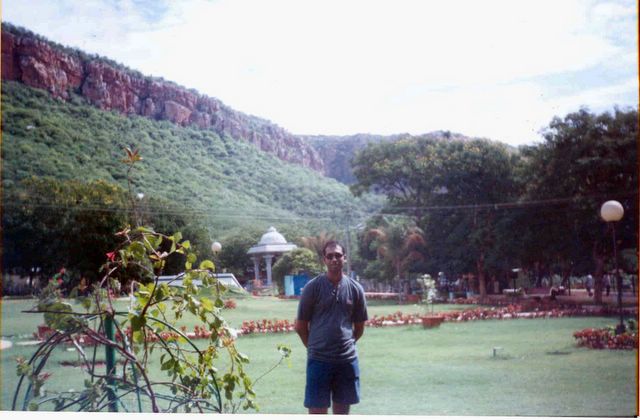
For first time i've set foot on the seven hills I was mesmerised but the sanctity of the place and divinity of nature. Me being a proper city goer never have ever seen such a beautiful place ever in my life, full of hills and valleys, greenary and water spots..Thats the closest to nature I thought I could ever get . Then in 2001 I had my 1st toncture to Lord Balaji, 2nd time went I hadn't had it.
My 2003 visit...
This is a snap from Aler which is the last stop before embarking the seven sacred hills..

This time in 2005 I am planning to have one, I am thankful to Almighty in my senses. I truly dedicate anything in me to him wholy, and sincerly hope I'll die by his name.
I truly want to be there again and again be at his service always ....

View My Stats

web site stat